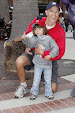
In our never-ending quest to expose Miguel to a variety of cultural experiences, we brought him to two, yes, two museums this week while he’s on winter break from middle school. Unconfirmed reports that our parenting behavior is being closely monitored by the International Red Cross and Amnesty International are false.
On Monday, we went to the De Young Museum in San Francisco and saw the King Tut exhibit with my brother-in-law and niece, Katy, who is not quite three months older than Miguel.
As we waited in line to enter, I puffed my chest out slightly and announced to my family and everyone else within earshot because of my booming voice that I was probably the only one there who’d actually been to King Tut’s tomb in Egypt.
“I could probably be the tour guide inside the exhibit,” I said.
Miguel probably rolled his eyes. As did Verna.
I visited Egypt in 1980 when I was a student in Israel for my junior year of college. My friend Dan and I hitchhiked in a taxi across the Sinai Desert with five other tourists and spent nine days in Egypt, just months after the border between Israel and Egypt had officially opened.
After exploring Cairo and Giza, site of the pyramids and the Sphinx, we boarded a 12-hour train ride to Luxor. I promptly got dysentery, derailing our plans to travel to King Tut’s tomb, about 8 miles outside the city on unpaved roads. Dan went by himself. The following day, no longer violently ill, I rented a moped and a driver of sorts and bumped and bounced my way to the tomb.
I don’t remember much about the tomb. I do know that when the original exhibit toured the United States in the late 70s, I was a college student in New York and tickets were the hottest item in town. It was rock concert crazy as long, long lines formed outside the museum as people waited to purchase entrance to the gold and glitter of the Boy Pharaoh.
None of this mattered much to Miguel even though I retold the story of my trip to Egypt to him while we stood in line.
In the end, he liked the exhibit. Verna had purchased the tickets at a discount from Costco, hoping to offset the traditional Christmas gifts with something of cultural substance, which included vouchers for an audio tour.
Miguel was pretty blown away with how the 3000-year old artifacts have held up so well over the centuries. He was grossed out by the Canopic jars, funerary containers that held the bodily organs of the Egyptian kings, queens, and other officials. But he liked King Tut’s gold dagger, the one that was buried with him when he died mysteriously at 19.
At one point, he and Katy asked if they could get something in the gift shop. I said, “Yes, but only if you can tell me three facts about the exhibit. And not that King Tut was the Pharaoh. Something more than that.”
They both said, “OK.”
A half a dozen facts later, Miguel and Katy were inside the gift shop, a kind of sickening homage to consumptive excess. OK, I know that the museum needs money, but King Tut shot glasses, magnets, pencils, and note pads?
The gift shop only increased the creeping unease I’d been feeling for most of the time we were there. The exhibit was fascinating and the artifacts very interesting, but I felt on some level that it was wrong for Howard Carter and his team to have unearthed the Tomb’s remains in 1922. We should let the dead remain in peace.
“How would you feel if someone went through your gravesite in 2000 years?” I posed to my brother-in-law, Marty.
“That’s fine with me,” he said. “Then they’ll see my Grateful Dead t-shirt, and they can do whatever they want.”
Miguel settled on a container in the shape of King Tut’s head. Not for use as a funerary depository, Miguel’s container will hold his puka shell necklace and other jewelry before basketball and baseball games.
We bought some King Tut-Egyptian stickers for Maya, who was across the street at the Steinhart Aquarium with her grandfather. I tried on a few Pharaoh headdresses and did my best imitation of Yul Brynner from The Ten Commandments:
“So it is written. So it shall be done.”
Yesterday we took everyone, including Maya, to the Charles Schulz Museum in Santa Rosa, which is about 40 minutes north of where we live. Schulz, a simple and gentle man who earned at one point 30-40 million dollars a year, bequeathed the center, which housed his office, to the museum after his death.
The museum, with live size models of various Peanuts character dotting the grounds, also showcases a brief history of comics in America to the evolution of Peanuts from the Lil Folks cartoon strip in Minneapolis, MN, to a worldwide phenomenon.
Peanuts has always been one of my favorite comic strips, and I’ve read it daily for more than 40 years. I laughed out loud yesterday several times as I read the panels from the 1950s, 60s, 70s, 80s, and all the way up to Schulz’s last ones in 1999. He was funny, sweet-natured, and possessed a tremendous amount of empathy for young people. We even watched a fascinating 60 Minutes interview with Schulz, done a few months before he was diagnosed with colon cancer.
As I stared at one of the enlarged panels I whispered (if that is possible for me) to my brother-in-law, “I think I like this exhibit even better than King Tut.”
Later I asked Verna to compare them. “You can’t,” she said. “It’s apples and oranges.”
I guess for me there was guilt that the King Tut exhibit should never have seen the light of day, while the Schulz Museum was uncomplicated and carefree joy over a comic strip I have loved since I was a kid.
I am glad we went to both, though. I learned a lot at each one. And I know Miguel and the rest of the family did as well.
Being the happy consumer already at such a young age, Miguel picked out a Peanuts collection of all the strips from 1963, which he bought with his own holiday money. He read it last night and stopped at times to share particularly funny ones with Verna and me. I left for work this morning with Miguel deposited on the couch reading Peanuts comics from more than 40 years ago.
Who says exposing kids to ‘culture’ is a bad thing? Then again, isn’t everything culture?
Showing posts with label families. Show all posts
Showing posts with label families. Show all posts
Wednesday, December 30, 2009

Friday, November 27, 2009
Gigi and the Dog Eat Dog World
I just started reading Eating Animals by Jonathan Safran Foer, in part because I am once again a human ping pong ball. First, I was a vegetarian for 30 years, then I stopped for three weeks because Verna was worried about my health, then I jumped back on the meatless bandwagon three weeks later, then this summer I started eating sustainable chicken and fish. But about a month ago, I realized (yet again) that I am a vegetarian and that is how I want to live in this world, so…
Reading Safran Foer’s book will probably confirm my choice. Next up The Vegetarian Myth, once it becomes available from the library. This book says the real culprit is industrial agriculture and not eating animal flesh may actually be detrimental to one’s body.
So who knows where’ll I’ll be eating-wise in a few weeks, chomping on slabs on beef, wolfing down rotisserie barbecued chicken? Doubtful. But I close the door on nothing.
I see the parallels between Safran Foer and myself. Neither of us liked animals all that much even though we either rarely ate them or abandoned our omnivorous ways altogether. But Safran Foer, like me, became a dog lover later in life and that surprised him.
And me as well.
We had a pet for five days when I was a kid. A puppy my father brought home that barked through the night and peed everywhere and drove my mother crazy. She made us get rid of it, and I cried at having to lose the little fellow who slept in my room.
A former girlfriend and I bought a puppy on a total whim at a Farmer’s Market outside Vermont more than 30 years ago. We soon realized neither of us, both college students at the time, was equipped to care for it, so we gave it away.
So I grew up with very little contact with animals in my own home outside of the occasional run in with spiders, crickets, and ants. Maybe once we had a goldfish. But there were no hamsters, bunnies, kitties, or anything else. And I didn’t particularly like animals all that much anyway.
Now my sentimental or sense of justice side came out from time to time. The political action group I worked for in Hartford, CT, in the early 1980s always hosted a holiday fundraiser that featured a plethora of items on which people could bid and buy. Someone put up a sheep for auction and the buzz around the room was that Nick Nyhart and a few friends were going to buy it for slaughter and consumption.
I quickly ran up to my friend and housemate Georgette. “We can’t let them kill the sheep,” I said.
“No, we can’t,” she said.
“What if we were to get a group of people together to buy the sheep and save its life?”
So Georgette and I scoured the room for partners as the bidding began. We rounded up three more people and raised $120, enough to outbid Nick and his gang. Georgette made arrangements with farmer-homeowners in Eastern Connecticut, where our sheep presumably lived out its days in relative peace and tranquility.
But the sheep episode was easy. I never met the sheep, didn’t have to interact with it, bath it, or clean it after it got sick or soiled itself. Nothing. The fact is I didn’t like caring for animals. Poopy diapers, hysterical children? Yes, as long as they’re my own. Animals? No thanks.
I worked on a kibbutz for three weeks when I lived in Israel during my junior year in college in 1979-80. One of my jobs was to collect the eggs in the henhouse. I got so upset at the little buggers pecking at my fingers and hands that I sometimes threw their eggs back at them. I was cruel.
My attitude towards animals and animal care changed a little over a year ago when we got Gigi, a miniature poodle. Verna fell in love with her immediately after she wandered into a pet store in Pismo Beach with our sister-in-law and then 18-year old niece. Verna called me on my cell phone, for I was at an Arroyo Grande Park at the time with Miguel, Maya, another niece and nephew, and my mother-in-law.
“I can’t believe you’re asking me to make such a decision on a cell phone while I'm at the park,” I nearly shouted to Verna. “We have to agree right?”
“Yes,” she said.
“OK, then I don’t want a dog. I don’t want any pets. Too much work.”
Verna came home with pictures of the poodle on her cell phone. I said she was cute, but I didn’t want a dog. Verna returned to the store and snapped more photos with her digital camera. Yes, I agreed, she is very cute, but I still don’t want her. We had dinner plans that night with the kids (two of ours, four of my brother-in-law and sister-in-law’s) and the adults in San Luis Obispo, where we were to meet my brother-in-law after work and his eldest, Erik, and Erik’s very pregnant girlfriend. Verna made us stop, hungry, at the pet store to meet the puppy. Yes, I agreed again, she was very cute, but I don’t want a dog.
Then I turned down the aisle and found Maya on the floor with the dog rolling in her lap. That’s when I realized it wasn’t about me. The kids will love her, I knew, so I relented but not before exacting a few concessions from the peanut gallery:
1. I will not have to scoop her poop
2. Miguel will never ask us for another gift for at least a year
3. My eldest niece would quit smoking
4. Miguel will be the primary caretaker for the dog he named Gigi
So we brought Gigi home a couple of days later and I spent nearly a week stewing about the dog. “Why did we have to get her?” “How much money is this going to cost?” “Why did I let you talk me into this?”
Gigi was relatively quiet and passive, but I wasn’t used to the small mounds of poop or the tiny streams of piss she left as presents in the kitchen and living room. And I was taking her out at night.
Well, eventually I calmed down and grew to love Gigi. She is sweet and makes almost no demands on us. Yes, she wants to be fed and use the neighboring park to pee and poop, but she is pretty low maintenance. She is happiest when someone gently strokes her belly.
And what happened to me, the guy who never really liked animals even though I wouldn't eat them? I am the alpha male. Gigi will abandon just about everyone and everything to come over to me. I am her go-to guy and that has helped bond us together. She is a member of our family and I like having her around.
I guess I could say on this day after Thanksgiving that I am grateful she is in our lives. As for the “promises” made to me once I caved in about Gigi, not one has held up. I scoop poop all the time; Miguel helps but is certainly not the sole caretaker, and he still asks for presents, gifts, and assorted stuff all the time (hey, he's a kid). And my niece, well, we’re sort of, kind of working on that.
But it truly doesn’t matter. I love Gigi, she loves me, and we’re a happy family. Corny and true.
Reading Safran Foer’s book will probably confirm my choice. Next up The Vegetarian Myth, once it becomes available from the library. This book says the real culprit is industrial agriculture and not eating animal flesh may actually be detrimental to one’s body.
So who knows where’ll I’ll be eating-wise in a few weeks, chomping on slabs on beef, wolfing down rotisserie barbecued chicken? Doubtful. But I close the door on nothing.
I see the parallels between Safran Foer and myself. Neither of us liked animals all that much even though we either rarely ate them or abandoned our omnivorous ways altogether. But Safran Foer, like me, became a dog lover later in life and that surprised him.
And me as well.
We had a pet for five days when I was a kid. A puppy my father brought home that barked through the night and peed everywhere and drove my mother crazy. She made us get rid of it, and I cried at having to lose the little fellow who slept in my room.
A former girlfriend and I bought a puppy on a total whim at a Farmer’s Market outside Vermont more than 30 years ago. We soon realized neither of us, both college students at the time, was equipped to care for it, so we gave it away.
So I grew up with very little contact with animals in my own home outside of the occasional run in with spiders, crickets, and ants. Maybe once we had a goldfish. But there were no hamsters, bunnies, kitties, or anything else. And I didn’t particularly like animals all that much anyway.
Now my sentimental or sense of justice side came out from time to time. The political action group I worked for in Hartford, CT, in the early 1980s always hosted a holiday fundraiser that featured a plethora of items on which people could bid and buy. Someone put up a sheep for auction and the buzz around the room was that Nick Nyhart and a few friends were going to buy it for slaughter and consumption.
I quickly ran up to my friend and housemate Georgette. “We can’t let them kill the sheep,” I said.
“No, we can’t,” she said.
“What if we were to get a group of people together to buy the sheep and save its life?”
So Georgette and I scoured the room for partners as the bidding began. We rounded up three more people and raised $120, enough to outbid Nick and his gang. Georgette made arrangements with farmer-homeowners in Eastern Connecticut, where our sheep presumably lived out its days in relative peace and tranquility.
But the sheep episode was easy. I never met the sheep, didn’t have to interact with it, bath it, or clean it after it got sick or soiled itself. Nothing. The fact is I didn’t like caring for animals. Poopy diapers, hysterical children? Yes, as long as they’re my own. Animals? No thanks.
I worked on a kibbutz for three weeks when I lived in Israel during my junior year in college in 1979-80. One of my jobs was to collect the eggs in the henhouse. I got so upset at the little buggers pecking at my fingers and hands that I sometimes threw their eggs back at them. I was cruel.
My attitude towards animals and animal care changed a little over a year ago when we got Gigi, a miniature poodle. Verna fell in love with her immediately after she wandered into a pet store in Pismo Beach with our sister-in-law and then 18-year old niece. Verna called me on my cell phone, for I was at an Arroyo Grande Park at the time with Miguel, Maya, another niece and nephew, and my mother-in-law.
“I can’t believe you’re asking me to make such a decision on a cell phone while I'm at the park,” I nearly shouted to Verna. “We have to agree right?”
“Yes,” she said.
“OK, then I don’t want a dog. I don’t want any pets. Too much work.”
Verna came home with pictures of the poodle on her cell phone. I said she was cute, but I didn’t want a dog. Verna returned to the store and snapped more photos with her digital camera. Yes, I agreed, she is very cute, but I still don’t want her. We had dinner plans that night with the kids (two of ours, four of my brother-in-law and sister-in-law’s) and the adults in San Luis Obispo, where we were to meet my brother-in-law after work and his eldest, Erik, and Erik’s very pregnant girlfriend. Verna made us stop, hungry, at the pet store to meet the puppy. Yes, I agreed again, she was very cute, but I don’t want a dog.
Then I turned down the aisle and found Maya on the floor with the dog rolling in her lap. That’s when I realized it wasn’t about me. The kids will love her, I knew, so I relented but not before exacting a few concessions from the peanut gallery:
1. I will not have to scoop her poop
2. Miguel will never ask us for another gift for at least a year
3. My eldest niece would quit smoking
4. Miguel will be the primary caretaker for the dog he named Gigi
So we brought Gigi home a couple of days later and I spent nearly a week stewing about the dog. “Why did we have to get her?” “How much money is this going to cost?” “Why did I let you talk me into this?”
Gigi was relatively quiet and passive, but I wasn’t used to the small mounds of poop or the tiny streams of piss she left as presents in the kitchen and living room. And I was taking her out at night.
Well, eventually I calmed down and grew to love Gigi. She is sweet and makes almost no demands on us. Yes, she wants to be fed and use the neighboring park to pee and poop, but she is pretty low maintenance. She is happiest when someone gently strokes her belly.
And what happened to me, the guy who never really liked animals even though I wouldn't eat them? I am the alpha male. Gigi will abandon just about everyone and everything to come over to me. I am her go-to guy and that has helped bond us together. She is a member of our family and I like having her around.
I guess I could say on this day after Thanksgiving that I am grateful she is in our lives. As for the “promises” made to me once I caved in about Gigi, not one has held up. I scoop poop all the time; Miguel helps but is certainly not the sole caretaker, and he still asks for presents, gifts, and assorted stuff all the time (hey, he's a kid). And my niece, well, we’re sort of, kind of working on that.
But it truly doesn’t matter. I love Gigi, she loves me, and we’re a happy family. Corny and true.
Friday, October 16, 2009
Return of the Undergraduate History Club
Hey, at least I haven’t made Miguel memorize the encyclopedia or translate the dictionary. I’ve just resurrected a tiny history club. Someday he’ll thank me for harassing, er, encouraging him to learn more.
I hope.
When Miguel and I received some stamps of civil rights pioneers I thought, “Wouldn’t it be great if Miguel, Verna, and I each researched one pioneer and reported back during dinner?”
Miguel rolled his eyes when I suggested it. Verna did the same. I pulled her aside and asked her to support me. OK, she’s got a lot on her plate these days, but she somehow saw a sliver of wisdom in my attempts to expand the family knowledge base.
Miguel eventually chose Medgar Evers; Verna picked Fannie Lou Hamer; and I settled on someone I’d never heard of, J.R. Clifford. The rules were simple: research your person and present information about him or her in your own words.
I took the idea for the Wefald-Friedman History Club from my undergraduate days at Columbia University in NYC. One time I was sitting in the quad with a group of friends, gazing out at the massive library and pondering ways to get laid without paying for it, when we decided to form the Undergraduate History Club in order to satisfy our thirst for knowledge and take our minds off our unsuccessful attempts to nail co-eds. The other three guys were members of the Columbia rowing team and I was a reporter for the school newspaper, the Columbia Daily Spectator.
Each week we submitted questions to another group member and then shared our findings over snacks and beers. I only remember one question anyone ever posed: what is the significance of Kashmir in the song of the same name by Led Zeppelin?
Probably the biggest accomplishment of the Undergraduate History Club, beyond minor edification, was when Rolling Stones tickets went on sale at the Brendan Byrne Arena in 1982. The four of us—Dave, Noah, Allen, and I—decided to send in 100 self-addressed stamped envelopes in order to score a pair of seats through the lottery.
On the day of the envelope addressing and licking party, only two of us—Dave and Allen—were available, so they worked in proxy for the whole group. I can’t vouch 27 years later for Noah’s whereabouts back then, but I am pretty sure I had a late afternoon history class.
Anyway, a few weeks later Dave got a voucher in the mail good for two tickets to the show. The club reconvened to decide which one of the remaining three would accompany him. Allen, a pre-med student with an inflated ego to match his bulging rower’s pectorals, said he deserved the other ticket because he and Dave had done all the work to mail off the envelopes.
Noah and I countered that that wasn’t the original agreement, invoking the spirit of the club, which was pretty close to the Three Musketeers’ credo of ‘All for One and One for All’. Allen was forced to back down. Plus he already had tickets to see the Stones in Philadelphia.
Dave put three strips of white paper behind his back, one colored with red marker. Allen, Noah, and I each pulled a strip and I was the lucky recipient of the red one and the right to be Dave’s date to the concert.
Allen skulked around for a bit more, but we ignored him as I bubbled with excitement about attending a major rock show—The Rolling Stones with Tina Turner as the opening act.
So why not resurrect the history club in my own household? Outside of our libidinal pursuits and a minor clash over the Rolling Stones, we’d had fun and learned a bit.
Neither Miguel nor Verna had completed their assignments on time, so the Wefald-Friedman History Club had to postpone its inaugural meeting to Sunday night, October 12. On that evening, Miguel shared some facts about Medgar Evers, which was topically relevant because there’d been a news item earlier that the Navy had named a ship for the slain civil rights leader. And Verna talked about Fannie Lou Hamer, who, like Verna, had an early October birthday.
I learned that J.R. Clifford was the first African-American attorney in West Virginia and a Civil War veteran, and helped to form a group that became the predecessor to the NAACP.
Then we wrote out questions for this week and gave them to each other. Miguel asked Verna to answer three ways in which energy can be transferred. I asked him to share three important things about Dr. Spock. And Verna asked me how her high school—Presentation—got its name and the religious significance of the order.
Miguel started his assignment last night, a day early, and shared with us that Dr. Spock wrote a best-selling baby book and introduced psychoanalysis into his treatment of children and families.
“Miguel, what’s psychoanalysis?” I asked. One rule of our club is you have to be able to define the information you uncover.
He looked at me. “I don’t know. It’s got something to do with treating psychos.”
“No, that’s not it,” I said. “Go find out,” which he did, though I am not sure he understands the finer points of Freud and therapy. Then, again, he is only 11. But look at the jump on knowledge he’ll have when he gets to college should he decide to form his own history club. Something tells me he’ll also be a lot more successful with females as well. But until then, he’s going to have to settle for the comfort of the encyclopedia and the dictionary.
I hope.
When Miguel and I received some stamps of civil rights pioneers I thought, “Wouldn’t it be great if Miguel, Verna, and I each researched one pioneer and reported back during dinner?”
Miguel rolled his eyes when I suggested it. Verna did the same. I pulled her aside and asked her to support me. OK, she’s got a lot on her plate these days, but she somehow saw a sliver of wisdom in my attempts to expand the family knowledge base.
Miguel eventually chose Medgar Evers; Verna picked Fannie Lou Hamer; and I settled on someone I’d never heard of, J.R. Clifford. The rules were simple: research your person and present information about him or her in your own words.
I took the idea for the Wefald-Friedman History Club from my undergraduate days at Columbia University in NYC. One time I was sitting in the quad with a group of friends, gazing out at the massive library and pondering ways to get laid without paying for it, when we decided to form the Undergraduate History Club in order to satisfy our thirst for knowledge and take our minds off our unsuccessful attempts to nail co-eds. The other three guys were members of the Columbia rowing team and I was a reporter for the school newspaper, the Columbia Daily Spectator.
Each week we submitted questions to another group member and then shared our findings over snacks and beers. I only remember one question anyone ever posed: what is the significance of Kashmir in the song of the same name by Led Zeppelin?
Probably the biggest accomplishment of the Undergraduate History Club, beyond minor edification, was when Rolling Stones tickets went on sale at the Brendan Byrne Arena in 1982. The four of us—Dave, Noah, Allen, and I—decided to send in 100 self-addressed stamped envelopes in order to score a pair of seats through the lottery.
On the day of the envelope addressing and licking party, only two of us—Dave and Allen—were available, so they worked in proxy for the whole group. I can’t vouch 27 years later for Noah’s whereabouts back then, but I am pretty sure I had a late afternoon history class.
Anyway, a few weeks later Dave got a voucher in the mail good for two tickets to the show. The club reconvened to decide which one of the remaining three would accompany him. Allen, a pre-med student with an inflated ego to match his bulging rower’s pectorals, said he deserved the other ticket because he and Dave had done all the work to mail off the envelopes.
Noah and I countered that that wasn’t the original agreement, invoking the spirit of the club, which was pretty close to the Three Musketeers’ credo of ‘All for One and One for All’. Allen was forced to back down. Plus he already had tickets to see the Stones in Philadelphia.
Dave put three strips of white paper behind his back, one colored with red marker. Allen, Noah, and I each pulled a strip and I was the lucky recipient of the red one and the right to be Dave’s date to the concert.
Allen skulked around for a bit more, but we ignored him as I bubbled with excitement about attending a major rock show—The Rolling Stones with Tina Turner as the opening act.
So why not resurrect the history club in my own household? Outside of our libidinal pursuits and a minor clash over the Rolling Stones, we’d had fun and learned a bit.
Neither Miguel nor Verna had completed their assignments on time, so the Wefald-Friedman History Club had to postpone its inaugural meeting to Sunday night, October 12. On that evening, Miguel shared some facts about Medgar Evers, which was topically relevant because there’d been a news item earlier that the Navy had named a ship for the slain civil rights leader. And Verna talked about Fannie Lou Hamer, who, like Verna, had an early October birthday.
I learned that J.R. Clifford was the first African-American attorney in West Virginia and a Civil War veteran, and helped to form a group that became the predecessor to the NAACP.
Then we wrote out questions for this week and gave them to each other. Miguel asked Verna to answer three ways in which energy can be transferred. I asked him to share three important things about Dr. Spock. And Verna asked me how her high school—Presentation—got its name and the religious significance of the order.
Miguel started his assignment last night, a day early, and shared with us that Dr. Spock wrote a best-selling baby book and introduced psychoanalysis into his treatment of children and families.
“Miguel, what’s psychoanalysis?” I asked. One rule of our club is you have to be able to define the information you uncover.
He looked at me. “I don’t know. It’s got something to do with treating psychos.”
“No, that’s not it,” I said. “Go find out,” which he did, though I am not sure he understands the finer points of Freud and therapy. Then, again, he is only 11. But look at the jump on knowledge he’ll have when he gets to college should he decide to form his own history club. Something tells me he’ll also be a lot more successful with females as well. But until then, he’s going to have to settle for the comfort of the encyclopedia and the dictionary.
Subscribe to:
Posts (Atom)